

The Taxi Driver
Some conversations stick with you. This one changed my perspective on life.

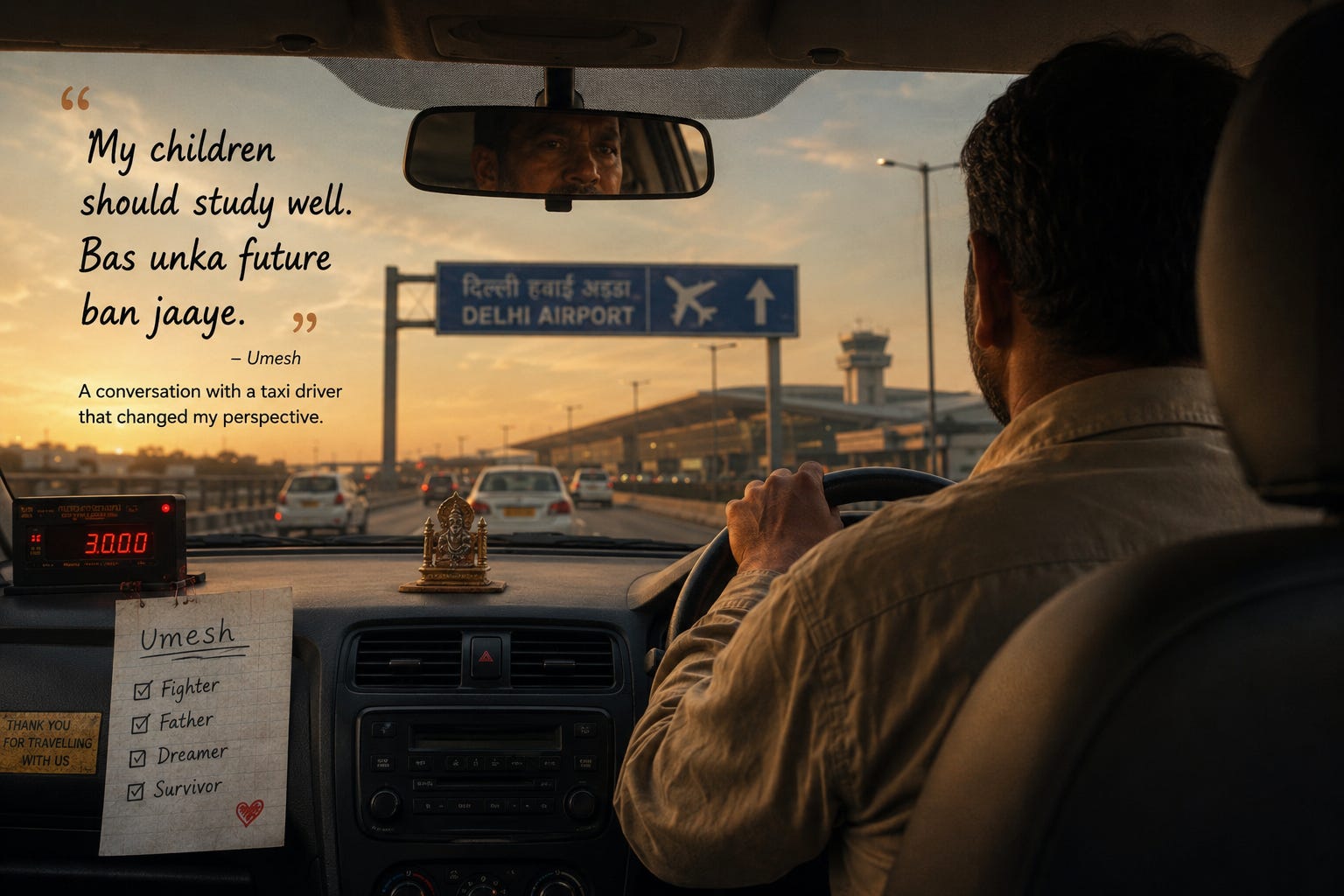
Some conversations stay with you longer than the destination itself. Mine happened in the backseat of a cab speeding toward the glowing chaos of Delhi airport at dawn. The kind of ride you forget by the time you reach security check — except this one quietly rearranged something inside me.
The driver’s name was Umesh.
At first, he was just another man navigating traffic with one hand on the wheel and the radio humming softly in the background. Then somewhere between a red light and a flyover, life spilled out.
His wife had left him five years ago.
Not after a dramatic fight. Not after some cinematic betrayal. She simply walked away, leaving him to raise their son and daughter alone. He said it matter-of-factly, the way people talk when pain has become sedimentary — settled too deep to be performed anymore.
There was no self-pity in his voice. That’s what struck me first.
Most people, after being abandoned with two children and a ₹30,000 monthly income in a city that eats money for breakfast, would understandably speak with bitterness. Umesh spoke with determination.
“My children should study well,” he said. “Bas unka future ban jaaye.”
That sentence carried the weight of an entire life philosophy.
He told us how seriously he takes their education. How every expense is calculated around school fees, books, coaching, uniforms. How he dreams of one day owning a flat — not because he cares about property as status, but because stability is the ultimate luxury for people who’ve never had it.
He earns barely enough to survive. Yet he speaks like a man investing in a future he may never personally enjoy.
And then came the part that changed the atmosphere inside the taxi entirely.
After his wife left, he spiraled into alcoholism and depression.
He admitted it without embarrassment. No masculine performance. No ‘men don’t cry’ bravado. Just honesty. There were days he drank too much. Days he didn’t want to continue. Days life felt heavier than his body could carry.
But then he looked at his children.
And something shifted.
“Nahi sambhalta toh bachchon ka kya hota?” he said.
If he didn’t pull himself together, what would happen to them?
My father was sitting beside me during this conversation, unusually quiet. Then slowly, almost cautiously, he began relating to Umesh’s story. When my father lost his job years ago, alcoholism and depression had also entered our lives like uninvited tenants. Listening to these two men — from entirely different worlds — speak the same emotional language felt strangely profound.
Pain, I realized, is deeply democratic.
A man driving a taxi through Delhi traffic and a middle-class father who once lost professional stability could arrive at the exact same emotional cliff edge. Shame. Failure. Escapism. Despair. The specifics change; the ache doesn’t.
But what moved me most wasn’t their suffering. It was their recovery.
Neither man described healing in grand terms. There were no motivational slogans. No LinkedIn-style ‘comeback’ narratives. Survival, for them, was quieter. More practical. Wake up. Go to work. Feed your children. Keep going because someone depends on you.
We often romanticize resilience online. We turn it into aesthetics and quotes pasted over sunsets. But real resilience looks like Umesh driving twelve-hour shifts while worrying about tuition fees. It looks like fathers swallowing their own grief because their children cannot afford for them to collapse.
And perhaps that’s why the conversation stayed with me long after the airport announcements swallowed us whole.
I spend a lot of time online, where ambition is measured loudly — salaries, promotions, followers, aesthetics, ‘soft life’ aspirations. But in that cab, success looked radically different. Success was a man who refused to let heartbreak destroy his children’s future.
Umesh may not own a flat yet. He may still struggle some days. But he has already built something more impressive than property: emotional endurance.
There’s a specific kind of dignity in people who keep going not because life became easier, but because someone else needed them to.
As I stepped out of the taxi, airport trolleys screeching around us and flights waiting to carry strangers elsewhere, I realized perspective rarely arrives through books or self-help podcasts. Sometimes it comes from a tired man in the driver’s seat telling you the truth about survival.
And sometimes, if you’re lucky, you listen.